
A business owner receives proposals for a new application, a sales system replacement, AI, and dashboards. All sound useful. Meanwhile, the everyday problems remain: late reports, hard-to-trace requests, and staff repeatedly copying information.
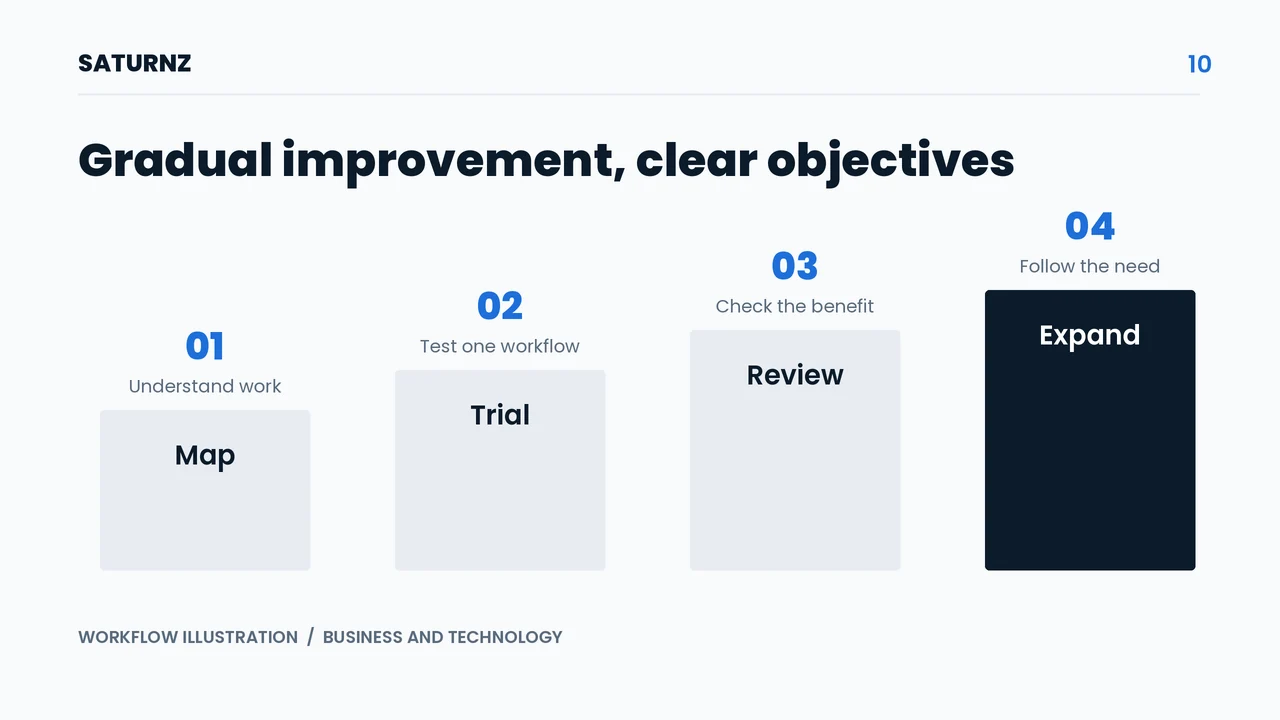
Digitalisation is easier to direct when it starts with work that needs improvement. The first objective should be clear enough to test with the team. Once a benefit is visible in a real process, the business has a basis for deciding what comes next.
List the workload you can observe
Ask the people doing the work to describe it. Look for repeated tasks, waiting time, and corrections. Use examples of documents and transactions with sensitive information removed.
Record frequency, the people involved, and what happens when work is delayed. Rebuilding a weekly report consumes time. Late order confirmation may affect a customer promise. Assess both in the context of the business.
Choose a problem with a process owner. This person helps agree on rules, assess results, and support adoption after the change is introduced.
Evaluate the benefit alongside readiness
Frequent processes with stable rules are often easier to trial within a limited scope. A process that is still changing may first need agreement on how the work should be done.
Review the information available. If item names or customer statuses are inconsistent, improving the records becomes part of the work. Connecting applications whose records mean different things can increase confusion.
OECD identifies digital skills and process integration among SME digitalisation challenges. For business managers, this supports including staff and process readiness in technology discussions from the beginning.
Define an initial implementation you can assess
Specify one workflow, a user group, and the intended result. For example, purchase requests at one branch could become traceable from submission to approval. Keep additional requirements tied to testing that initial objective.
Agree on how work will continue if something goes wrong and who provides assistance. Give staff time to try real tasks, including correcting mistakes. Training should follow their actual responsibilities so they understand when and why to use the system.
Check whether existing tools can meet the need before commissioning new software. Custom development becomes relevant when the workflow or connections between systems require changes that the current approach cannot adequately support.
Distinguish time saved from business results
Use measures you can collect: handling time per request, corrections, waiting work, or questions about status. Record a baseline for comparison after implementation.
As an illustrative calculation, 40 requests requiring three minutes of repeated data entry each represent two hours of work. If that step is reduced, review how the available time is used. These figures illustrate the calculation; they do not forecast savings for a particular business.
The business benefit may be additional capacity, clearer service, or better operational control. Conclusions should reflect actual use and the real work required to maintain the system.
Choose the next step from the findings
After several working cycles, review the experience with users. If many cases return to the old process, understand why before expanding. If the workflow is useful, select the next process directly related to the remaining need.
Saturnz can help map priorities, compare options, and plan a staged implementation. Browse the business solutions portfolio for examples, then discuss the process you want to improve. One recurring operational problem is enough to begin the conversation.