
Sales are growing, but administrators are working longer hours. Payment checks pile up, warehouse staff wait for order lists, and customers send messages asking for updates. The business has attracted demand; the next challenge is fulfilling it through a repeatable process.
Order automation can help when operating rules are clear. A system can pass information, send reminders, and prepare the next task. People remain responsible for changes, unusual cases, and customer relationships.
Separate routine work from decisions
Review an administrator’s activities during a working day. Copying addresses, sending the same confirmation, and preparing a list of paid orders are potential routine tasks. Approving a special discount or selecting a substitute for an unavailable item requires a decision.
This distinction defines the scope of automation. A system can prepare information for a decision while approval stays with the responsible person. A stock alert, for example, can send order details to staff without promising the customer a substitute product.
Write rules in language the operations team can review together. “An order is ready for preparation once payment is confirmed and stock is available” is easier to assess than an application feature list.
Give every status a clear meaning
An order status should indicate what happens next. “Processing” is too broad when it includes payment checks, picking, and packing.
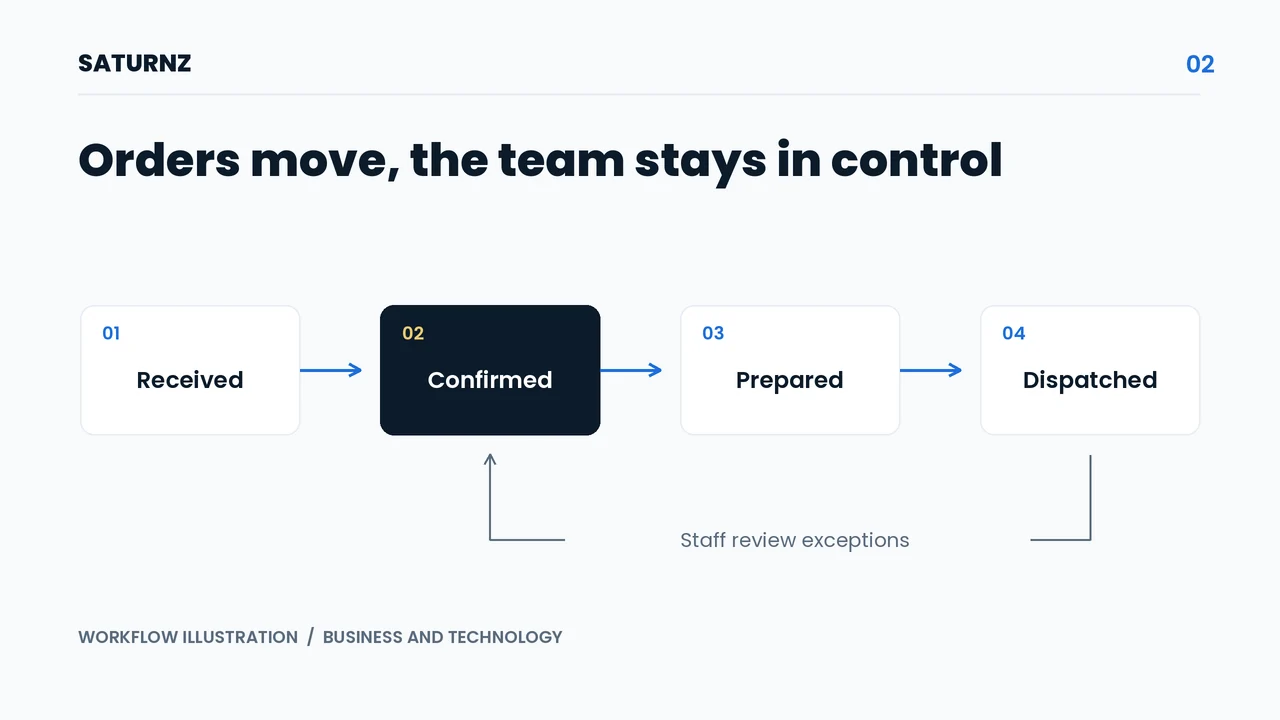
An illustrative workflow could use: received, awaiting payment, ready to prepare, ready to dispatch, and dispatched. Assign an owner to each stage. Customer service should see the same statuses when responding to buyers.
Status changes need to reflect the correct event. Acknowledging receipt of an order is different from confirming payment. Confusing the two gives customers an assurance the business may not yet be able to fulfil.
Plan for orders that break the usual pattern
An order may change after payment. A payment might not match, stock may be unavailable, or a customer may request a partial delivery. These situations need a visible review path.
Decide who receives the case, how long it can wait under your internal service standard, and how the customer will be updated. Recording the reason for a change helps the next staff member continue without asking the customer to repeat the story.
Check that one event cannot create two dispatches or conflicting messages. Include duplicate orders and cancellations when trying the new process so staff understand how to handle them.
Start with a recurring administrative burden
Choose one task with stable rules, such as preparing packing lists for eligible orders. Trial it with a limited product group or sales channel. Ask administrators and warehouse staff whether the output is usable in their daily work.
Record handling time per order, stalled orders, and corrections. Also monitor customer requests for status updates. A shorter internal process should translate into clearer service, rather than shifting work to another team.
Expand once the team understands the exceptions. Staff should also know how to continue working when the automated process is unavailable.
Supporting the next stage of growth
In the F&B sales portfolio, orders, payments, and fulfilment form one set of operational needs. This gives automation a practical purpose: making the next task happen so the customer receives the right order.
Discuss your order workflow with Saturnz using examples of routine and problematic transactions. We can help define the division of work between systems and staff, including measures to review after implementation.