
Two staff members accept requests for the same room at similar times. Both believe it is available because the conversations are on different phones. When customers arrive, a record-keeping problem becomes a service issue that must be resolved in front of guests.
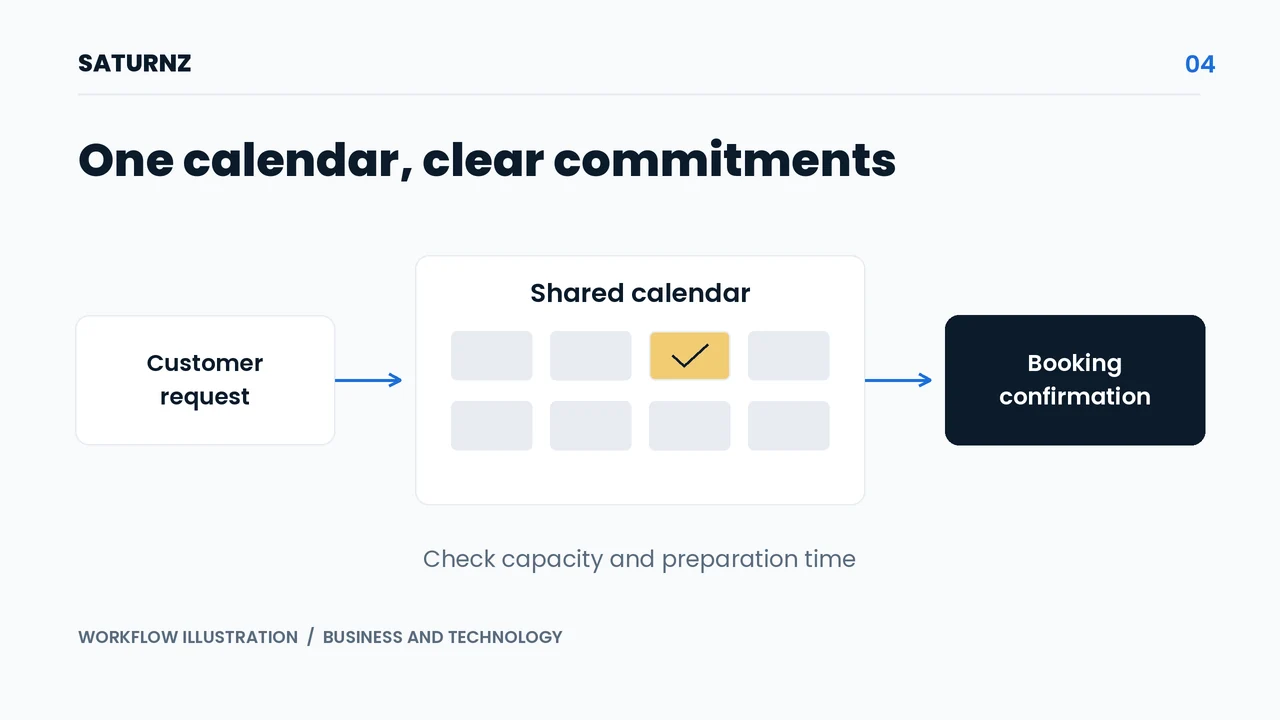
A reservation system helps a business manage its promises. Its value depends on clear capacity rules, statuses, and change procedures. A shared calendar gives sales, administrators, and service staff a common basis for coordination.
Define what the customer is booking
A table, a private room, and an event area have different needs. Alongside the start time, a business may need to record duration, party size, preparation time, and time to reset the space afterwards.
For illustration, a room is booked until 3 pm, but staff need time to prepare it for the next group. If the calendar only records the event itself, the next slot could appear available before the room is ready.
Define capacity around how the service operates. Involve the operations team in availability rules so promises made during booking can be fulfilled on site.
Distinguish a request from a confirmed booking
Submitting a form does not always mean a customer has secured the space. Some businesses first need to check requirements, obtain administrator approval, or confirm that booking conditions have been met.
Use understandable statuses: request received, awaiting confirmation, confirmed, cancelled, and completed. Customer messages should reflect those statuses. Explain the next action and when the customer can expect an update under the business’s service standard.
If you hold a slot temporarily, define its expiry and who may extend it. This prevents an unfinished request from blocking availability indefinitely.
Bring changes from every channel into one record
A customer may discover the business on its website and later change the booking through WhatsApp. Staff still need one reservation record as their reference. Update that record before offering a released slot to someone else.
Include the reason for changes, a contact person, and agreed service requirements. Staff on the next shift should have enough context to continue without reconstructing the conversation.
Notifications help communicate changes, but the shared calendar should remain the main reference. A large volume of messages does not guarantee that everyone has the same schedule.
Measure how reliably promises are fulfilled
Booking volume alone does not describe service quality. Review confirmation time, schedule conflicts, changes discovered too late, and customer no-shows. Group these by service type to make the causes easier to understand.
Also review space use by time slot. Quiet periods may call for a different offer, while busy periods require appropriate staffing and preparation. The data helps managers ask better questions before changing capacity or promotion.
Implementation shaped around the service
The table and space reservation portfolio connects availability, online requests, confirmations, and administration. Studios, sports venues, and appointment businesses may have similar coordination needs with different operating rules.
Saturnz can help map the journey from request to arrival, including rescheduling and cancellation. Bring examples of bookings that cause extra coordination to a reservation workflow consultation. The starting point is to clarify what is promised to the customer and what staff need in order to deliver it.